
“This great song, pulsating with the agony of a sin-stricken soul, helps us to understand the stupendous wonder of the everlasting mercy of our God.” (G. Campbell Morgan)
Allegri’s Miserere is a musical setting of Psalm 51, and is commonly sung on Ash Wednesday and during Holy Week before Easter. Psalms are sacred songs or hymns, sung or recited as part of Jewish or Christian worship. They are collected together in the first book of the Ketuvim (“Writings”) which forms the third section of the Hebrew Bible, and in a book of the Old Testament in the Christian Bible. There are 150 psalms in Jewish and Western Christian tradition and more in Eastern Christian Churches.
In the standard Hebrew text the Psalms are divided into five sections, but they can also be categorised by theme. Psalm 51: Miserere mei, Deus (“Have mercy upon me, O God”) is one of seven considered to be “penitential psalms“, each of which is concerned with an expression of sorrow for having sinned. Psalm 51 is attributed to King David, and represents his confession to God after he sinned with Bathsheba, as described in the bible at 2 Samuel, chapters 11–12.
David’s Sin and Act of Repentance
The story of David and Bathsheba tells of David’s great sin: his forced adultery with Bathsheba leading to pregnancy and his treacherous attempt to conceal his actions including the murder of Bathsheba’s husband. He is held to account by God; he repents, is punished, and forgiven. It can be read in full here:
- 2 Samuel 11 (NIV) (BibleGateway)
The following articles from the JesusWalk Bible Study Series provide an excellent commentary and explanation of the bible passage and Psalm 51:
In addition this analysis of Psalm 51 by David Guzak at Enduring Word is comprehensive:
You will find a great deal online to assist your own understanding of Psalm 51.
Use in Anglican and Catholic Liturgy
In the Anglican faith, Psalm 51 is part of the liturgy for Ash Wednesday set out in the Book of Common Prayer and a setting of the Miserere is sung during the service of Evensong on that day. Ash Wednesday marks the start of Lent, a period of six weeks of penitence and reflection observed before Easter.
In the Catholic faith, Psalm 51 is part of the Liturgy of the Hours or Divine Office, and is prayed during Lauds (Morning Prayer) every Friday. During Holy Week – the week leading up to Easter Sunday, the Miserere is the final psalm in a service called Tenebrae, meaning darkness in Latin. The Tenebrae service combines the offices of Matins and Lauds on the three days before Easter Sunday. Rather than being held at the usual times for Matins (the early hours) and Lauds (around daybreak), the three Tenebrae services are “anticipated” – brought forward – to the late afternoon of the preceding day, so occur on Holy or ‘Spy’ Wednesday, Maundy Thursday and Good Friday.
Tenebrae involves psalms, antiphons and readings pertinent to the events and mysteries of Holy Week, occurring three times in reflection of the three days and three nights that Christ lay in the tomb after his crucifixion. The service is characterised by the gradual extinguishing of 15 candles that are mounted on the two ascending sides of a triangular candelabra or Tenebrae “hearse”. The specific sequence of liturgical material used on each day and the points at which the candles are extinguished is laid out in the Wikipedia article here. Before the final psalm the remaining candle, still lit, is removed and placed behind the altar or in place where its light is no longer visible, symbolising the light of Christ extinguished with his death. After the psalm, the strepitus (loud noise) is made – perhaps by banging old hymn books against pews, or the stamping of feet – to represent the earthquake that followed Christ’s death. The single remaining candle is then replaced in its position, and all depart in silence.
Psalm Numbering
The Miserere is not always numbered as Psalm 51 and is sometimes referred to as Psalm 50. This is because the Roman Catholic Church follows the numbering and structure of the Psalms used in the Greek translation of the scriptures, whilst other Christian traditions use the numbering and structure based on the Hebrew version. Official Roman Catholic texts use the Greek numbering (Ps. 50), Protestant translations use Hebrew numbering (Ps. 51), and modern Roman Catholic texts use the Hebrew numbering but make note of the Greek number (Ps. 51 [50]).
Verse Numbering in Psalm 51
Psalm 51 has 19 verses. The full first verse [which includes the title in brackets] is written in the Book of Psalms like this:
“Have mercy upon me, O God, after thy great goodness:
according to the multitude of thy mercies do away mine offences.”
In his setting of the Miserere, Allegri splits the first verse in two resulting in 20 sections of text which are distributed to different groups of singers in the sequence: five voices, plainchant (solo or unison voices), 4 voices. The final verse is sung by both choirs together, i.e. nine voices.
In the discography, where recorded performances do not contain all the verses of the Miserere, we reference the sections that ARE included in terms of the 20 sections that make up the full setting by Allegri, to make comparison easier between different performances. The primary reasons for sections to be omitted are either that the performing edition being used doesn’t include them, which is typical of earlier settings that were either significantly shorter and/or didn’t include the plainchant verses, or that they have been omitted to create a shorter performance, making space for other works to be included.
Latin / English Translation : Allegri’s Verses
The English translation given below is from the 1662 Book of Common Prayer, as used by Ivor Atkins in his English edition of the Miserere, published by Novello in 1951).
The translation below shows how the music is distributed between the different groups of singers: verses sung by fives voices are in bold face, verses sung in unison are in plain text, and verses sung by four voices are in italics. The final verse is sung by both choirs together, resulting in nine parts.
1 |
Miserere mei, Deus, secundum magnam misericordiam tuam: |
Have mercy upon me, O God, after thy great goodness: |
2 |
Et secundum multitudinem miserationum tuarum, dele iniquitatem meam. |
According to the multitude of thy mercies do away mine offences. |
3 |
Amplius lava me ab iniquitate mea: et a peccato meo munda me. |
Wash me thoroughly from my wickedness: and cleanse me from my sin. |
4 |
Quoniam iniquitatem meam ego cognosco: et peccatum meum contra me est semper. |
For I acknowledge my faults: and my sin is ever before me. |
5 |
Tibi soli peccavi, et malum coram te feci: ut justificeris in sermonibus tuis, et vincas cum judicaris. |
Against thee only have I sinned, and done this evil in thy sight: that thou mightest be justified in thy saying, and clear when thou art judged. |
6 |
Ecce enim in iniquitatibus conceptus sum: et in peccatis concepit me mater mea. |
Behold, I was shapen in wickedness: and in sin hath my mother conceived me. |
7 |
Ecce enim veritatem dilexisti: incerta et occulta sapientiae tuae manifestasti mihi. |
But lo, thou requirest truth in the inward parts: and shalt make me to understand wisdom secretly. |
8 |
Asperges me hyssopo, et mundabor: lavabis me, et super nivem dealbabor. |
Thou shalt purge me with hyssop, and I shall be clean: thou shalt wash me, and I shall be whiter than snow. |
9 |
Auditui meo dabis gaudium et laetitiam: et exsultabunt ossa humiliata. |
Thou shalt make me hear of joy and gladness: that the bones which thou hast broken may rejoice. |
10 |
Averte faciem tuam a peccatis meis: et omnes iniquitates meas dele. |
Turn thy face from my sins: and put out all my misdeeds. |
11 |
Cor mundum crea in me, Deus: et spiritum rectum innova in visceribus meis. |
Make me a clean heart, O God: and renew a right spirit within me. |
12 |
Ne proiicias me a facie tua: et spiritum sanctum tuum ne auferas a me. |
Cast me not away from thy presence: and take not thy holy Spirit from me. |
13 |
Redde mihi laetitiam salutaris tui: et spiritu principali confirma me. |
O give me the comfort of thy help again: and stablish me with thy free Spirit. |
14 |
Docebo iniquos vias tuas: et impii ad te convertentur. |
Then shall I teach thy ways unto the wicked: and sinners shall be converted unto thee. |
15 |
Libera me de sanguinibus, Deus, Deus salutis meae: et exsultabit lingua mea justitiam tuam. |
Deliver me from blood-guiltiness, O God, thou that art the God of my health: and my tongue shall sing of thy righteousness. |
16 |
Domine, labia mea aperies: et os meum annuntiabit laudem tuam. |
Thou shalt open my lips, O Lord: and my mouth shall shew thy praise. |
17 |
Quoniam si voluisses sacrificium, dedissem utique: holocaustis non delectaberis. |
For thou desirest no sacrifice, else would I give it thee: but thou delightest not in burnt-offerings. |
18 |
Sacrificium Deo spiritus contribulatus: cor contritum, et humiliatum, Deus, non despicies. |
The sacrifice of God is a troubled spirit: a broken and contrite heart, O God, shalt thou not despise. |
19 |
Benigne fac, Domine, in bona voluntate tua Sion: ut aedificentur muri Ierusalem. |
O be favourable and gracious unto Sion: build thou the walls of Jerusalem. |
20 |
Tunc acceptabis sacrificium justitiae, oblationes, et holocausta: tunc imponent super altare tuum vitulos. |
Then shalt thou be pleased with the sacrifice of righteousness, with the burnt-offerings and oblations: then shall they offer young bullocks upon thine altar. |
Latin / English Translation : Book of Psalms
For completeness, here is Psalm 51 laid out as in the Book of Psalms:
1 |
Miserere mei, Deus, secundum magnam misericordiam tuam: Et secundum multitudinem miserationum tuarum, dele iniquitatem meam. |
Have mercy upon me, O God, after thy great goodness: According to the multitude of thy mercies do away mine offences. |
2 |
Amplius lava me ab iniquitate mea: et a peccato meo munda me. |
Wash me thoroughly from my wickedness: and cleanse me from my sin. |
3 |
Quoniam iniquitatem meam ego cognosco: et peccatum meum contra me est semper. |
For I acknowledge my faults: and my sin is ever before me. |
4 |
Tibi soli peccavi, et malum coram te feci: ut justificeris in sermonibus tuis, et vincas cum judicaris. |
Against thee only have I sinned, and done this evil in thy sight: that thou mightest be justified in thy saying, and clear when thou art judged. |
5 |
Ecce enim in iniquitatibus conceptus sum: et in peccatis concepit me mater mea. |
Behold, I was shapen in wickedness: and in sin hath my mother conceived me. |
6 |
Ecce enim veritatem dilexisti: incerta et occulta sapientiae tuae manifestasti mihi. |
But lo, thou requirest truth in the inward parts: and shalt make me to understand wisdom secretly. |
7 |
Asperges me hyssopo, et mundabor: lavabis me, et super nivem dealbabor. |
Thou shalt purge me with hyssop, and I shall be clean: thou shalt wash me, and I shall be whiter than snow. |
8 |
Auditui meo dabis gaudium et laetitiam: et exsultabunt ossa humiliata. |
Thou shalt make me hear of joy and gladness: that the bones which thou hast broken may rejoice. |
9 |
Averte faciem tuam a peccatis meis: et omnes iniquitates meas dele. |
Turn thy face from my sins: and put out all my misdeeds. |
10 |
Cor mundum crea in me, Deus: et spiritum rectum innova in visceribus meis. |
Make me a clean heart, O God: and renew a right spirit within me. |
11 |
Ne proiicias me a facie tua: et spiritum sanctum tuum ne auferas a me. |
Cast me not away from thy presence: and take not thy holy Spirit from me. |
12 |
Redde mihi laetitiam salutaris tui: et spiritu principali confirma me. |
O give me the comfort of thy help again: and stablish me with thy free Spirit. |
13 |
Docebo iniquos vias tuas: et impii ad te convertentur. |
Then shall I teach thy ways unto the wicked: and sinners shall be converted unto thee. |
14 |
Libera me de sanguinibus, Deus, Deus salutis meae: et exsultabit lingua mea justitiam tuam. |
Deliver me from blood-guiltiness, O God, thou that art the God of my health: and my tongue shall sing of thy righteousness. |
15 |
Domine, labia mea aperies: et os meum annuntiabit laudem tuam. |
Thou shalt open my lips, O Lord: and my mouth shall shew thy praise. |
16 |
Quoniam si voluisses sacrificium, dedissem utique: holocaustis non delectaberis. |
For thou desirest no sacrifice, else would I give it thee: but thou delightest not in burnt-offerings. |
17 |
Sacrificium Deo spiritus contribulatus: cor contritum, et humiliatum, Deus, non despicies. |
The sacrifice of God is a troubled spirit: a broken and contrite heart, O God, shalt thou not despise. |
18 |
Benigne fac, Domine, in bona voluntate tua Sion: ut aedificentur muri Ierusalem. |
O be favourable and gracious unto Sion: build thou the walls of Jerusalem. |
19 |
Tunc acceptabis sacrificium justitiae, oblationes, et holocausta: tunc imponent super altare tuum vitulos. |
Then shalt thou be pleased with the sacrifice of righteousness, with the burnt-offerings and oblations: then shall they offer young bullocks upon thine altar. |
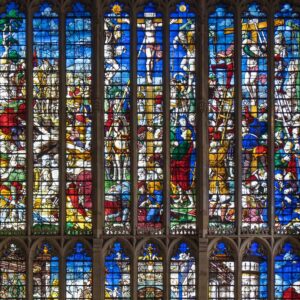
The picture of King’s College Cambridge – East Window used as the feature image for this page was created by DeFacto