
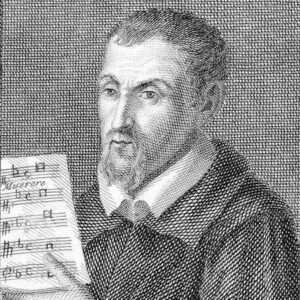
Considering the popularity of Gregorio Allegri’s legendary Miserere and the stories that surround it, relatively little appears to have been written about the man himself. Most of the biographical notes found online repeat the same information with minor variations, and none exist without reference to the Miserere. Even Graham O’Reilly’s comprehensive book (see pp. 29-31) borrows from Jean Lionnet’s notes that accompany A Sei Voci’s 1994 recording, and from the modern version of Grove’s Dictionary. As Lionnet points out:
“Of all famous composers, Gregorio Allegri (b 1582; d Rome, 17 February 1652) is no doubt the one whose music is the least well-known. All the legends that were built up around his Miserere in the 18th century have completely obliterated the composer and his work.”
Lionnet, Jean, ‘The Career of Gregorio Allegri’ from the CD liner notes of Gregorio Allegri – Miserere / Messe / Motets (Astrée, 1994)
Some of the earliest references to Allegri are to be found in William Bingley’s Musical Biography of 1814 (Vol. 1, pp. 164-167) and Sir John Hawkins’ A General History of the Science and Practice of Music (Vol. 4, pp. 89-91) published in 1776, around 125 years after Allegri’s death. Although he had published a version of the Miserere in London in 1771 there is no mention of Allegri in Charles Burney’s General History of Music (1776–89). Burney’s chapter on the ‘Roman School of Composition’ (Vol. 3, pp. 181-208) does however tell us about Giovanni Maria Nanino and his younger brother Bernadino, which is a useful segue to any biography of Allegri:
“He [Giovanni Maria Nanino] … was a fellow student and in strict friendship with Palestrina. These two excellent masters opened a Music-school together at Rome, where they formed many great scholars, among whom was Giov. Bernadino Nanino, a younger brother of Maria…”
Burney, Charles, ‘A General History of Music’ (Vol. 3, p. 199)
Gregorio Allegri, the eldest of three brothers, was born in 1582 and at the age of nine joined the choir shool at S. Luigi de Francesi in Rome in 1591 where Giovanni Bernadino Nanino was Maestro di Capella. When his voice broke, his place was taken by his younger brother Domenico, who was succeeded in the same way by Bartolomeo Allegri. From 1601, Gregorio returned to S. Luigi del Francesi either as a contralto (Lionnet), tenor (Byram-Wigfield), or tenor altus (Bigotti) and was instructed by both Nanino brothers, who would have been heavily influenced by their association with Palestrina. Some authors suggest that Allegri would have associated closely with Palestrina, though that could only have happened for a few years between 1591 and Palestrina’s death in 1594.
Gregorio became a priest, and worked at the cathedral of Fermo until 1628 when he returned to Rome to take the position of Maestro di Capella at La Chiesa Santo Spirito in Sassa. Whilst Gregorio was at Fermo, his brother Domenico had progressed to become Maestro at S. Maria Maggiore (where the Tallis Scholars were to record their concert “Live in Rome”). Domenico died in September 1629, and on 6th December of that same year Gregorio was admitted to the papal choir of the Sistine Chapel during the reign of Pope Urban VIII. Some biographers suggest that Allegri’s motets and instrumental concerti had attracted the notice of the Pope, influencing his decision to award Allegri the position. Each year, the Maestro of the Sistine Choir was elected by the body of singers themselves, and Allegri held this position from 1650 which was notably a “Year of Jubilee” – a holy year declared every 25 years by the Pope, and presumably a much busier time for the Capella and their chosen Maestro. He continued as Maestro until his death 2 years later.
Hawkins’ A General History of the Science and Practice of Music (1776), published at a time when the long s (ſ) was still in use, records that:
“Andrea Adami, ſurnamed da Bolſena, who has given a brief account of him, ſays that he was but an indifferent ſinger, but that he was diſtinguiſhed for his benevolent diſpoſition, which he manifeſted in his companion for the poor, whom he daily relieved in crouds at his own door, and in daily viſits to the priſons of Rome, and communications with thoſe confined there, whoſe diſtreſſes he enquired into and relieved to the extent of his abilities.”
Andrea Bolsena was principal biographer of the papal singers, and writes of Allegri that “the great esteem in which he [Allegri] was held by all the musical profession gave grounds for the Pope to have his received as Cantor in his Chapel.”
The following passage is reproduced verbatim from John Weeks Moore’s Complete Encyclopaedia of Music (1880):
“Though his abilities as a singer were not very conspicuous, yet he was reckoned a complete master of harmony, and was in such estimation with the performers of his time, that he was appointed by the pope, A. D. 1629, to a situation in the choir of his chapel. His principal compositions are of a sacred and solemn description; and many parts of the church service in Italy, remarkable for the divine simplicity and purity of the harmony, are at this day the evidences of his successful application to the musical art. To his skill as a composer he added a gentleness of disposition, and a warmth of benevolence, which showed that he was possessed of merit still higher and more enviable. The poor flocked around his abode, and were relieved by his charity; and guided by his exhortations. It was his daily business to visit the prisons of Rome, and to attend to the wants of the unhappy persons who were shut up in those dreary mansions.”
And this is how it is recorded in Hawkins’ A General History of the Science and Practice of Music (1776), published at a time when the long s was still commonplace in printing:
“Andrea Adami, ſurnamed da Bolſena, who has given a brief account of him, ſays that he was but an indifferent ſinger, but that he was diſtinguiſhed for his benevolent diſpoſition, which he manifeſted in his companion for the poor, whom he daily relieved in crouds at his own door, and in daily viſits to the priſons of Rome, and communications with thoſe confined there, whoſe diſtreſſes he enquired into and relieved to the extent of his abilities.”
Gregorio Allegri died on 17th February 1652 aged 70. Next day, the timekeeper (one of the officers of the papal choir) recorded that:
“When mass was over, the maestro di cappella announced to the assembly the death of Mr Gregorio Allegri, our companion and distinguished composer, which had occurred at the ninth hour of the previous night. The loss of such a valorous man was felt by the whole of our college with the greatest of sorrow. He had learned musical theory with Mr Giovanni Maria Nanino, who was in his time musician of our chapel, and had become so advanced in the excellence of counterpoint and composition that he had almost equalled his teacher in the arcana of music, and future generations will find evidence of this in the works he composed for our chapel”.
Allegri was buried in Rome, near the chapel of San Filippo Neri in the church of Santa Maria in Vallicella, also called the Chiesa Nueva, which was the common burial place for singers in the papal choir. A later engraving on the wall nearby reads:
Cantores pontificii, ne quos vivos, concors melodia junxit, mortuos corporis discors resolutio dissolveret, hic una condi voluere. Anno MDCCLXXXXII
The pontifical singers, anxious that those whom harmony united in life should not be separated in death, wished this as their burial-place. AD 1792
Future Research
A more detailed analysis of available biographical sources is one of the areas of research that we hope to carry out in the future. miserere.org would welcome any additional information readers may have on this topic, particularly any earlier references that shed light on Allegri’s life.
Further Reading
O’Reilly, Graham, ‘ ‘Allegri’s Miserere‘ in the Sistine Chapel’ (The Boydell Press, 2020)
Byram-Wigfield, Ben, ‘Gregorio Allegri: A Biography’, https://www.ancientgroove.co.uk/essays/biog.html (2018), accessed 27/2/25.
Bigotti, Fabrizio, ‘Gregorio Allegri: 17th Century Roman Protagonist’ from the liner notes of CD Gregorio Allegri: Unpublished works from the manuscripts of the Collectio Altaemps (Tactus, 2014)
Roche, Jerome (rev. O’Regan, Noel), ‘Gregorio Allegri‘ in Grove Music Online (OUP, 2001)
Lionnet, Jean, ‘The Career of Gregorio Allegri’ from the liner notes of CD Gregorio Allegri – Miserere / Messe / Motets (Astrée, 1994)
Author Unknown, ‘Allegri, Gregorio‘, Encyclopaedia Britannica, Volume 1 (1911)
Moore, John Weeks, ‘Allegri, Gregorio‘, Complete Encyclopaedia of Music (1880)
Bingley, William, ‘Gregorio Allegri’ (pp. 164-167) in Musical Biography; or Memoirs of the lives and writings of the most eminent musical composers and writers, who have flourished in the different countries of Europe during the last three centuries (Vol. 1) (Henry Colburn, London, 1814)
Hawkins, John, ‘Gregorio Allegri’ (pp. 89-91) in A General History of the Science and Practice of Music (Vol. 4) (T. Payne & Son, London, 1776)
da Bolsana, Andrea Adami, Osservazioni per ben regolare il coro de i cantori della Capella Pontificia (p. 198) (1711)
The picture of Gregorio Allegri used as the feature image for this page is after Francesco Faraone Aquila, Public domain, via Wikimedia Commons