
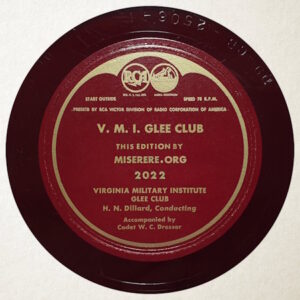
Directed by: H. N. DILLARD, Accompanied by: CADET W. C. DRESSER, Recorded at RCA Victor Studios, New York, 12 Nov 1949
We are delighted to present this digitally restored edition of an album containing what we believe is the earliest recorded and published performance of Allegri’s Miserere. After four years of investigation, the curator has been unable to find any evidence of an earlier recording. Perhaps one does exist, and perhaps publishing this page will help reveal it! This has been one of the most interesting and exciting finds of the project, its publication is dedicated to Lt. Col. Herbert Nash Dillard, and his niece and biographer Elizabeth (Betsy) Dillard Stroud who has so kindly shared her memories with us.
miserere.org has created a new, expanded digital booklet to accompany this re-issue which you are welcome to download. In the booklet and on this page, we have updated some of the language used in the original notes accompanying the album to a more modern idiom.
If you have a special interest in this recording, please do contact us – we’d love to hear from you.
01 – The VMI Spirit
This song needs no introduction to the alumni and friends of the Institute. It was written by Benjamin Bowering of the class of 1915, and has held first place in the hearts of all VMI men since its first appearance.
02 – Stouthearted Men
A favorite of all glee clubs, this song from “The New Moon” is a rousing call to arms and courage.
03 – Tutti venite amarti
This is a brief Sixteenth-Century Italian song, typical of the youth of all ages, about those soldiers of love fighting in the service of Dan Cupid.
04 – It Ain’t Necessarily So
One of the most popular of the songs from Gershwin’s folk opera, “Porgy and Bess,” this is a song of humorous cynicism sung by the “villain.” The excellent work of the soloist, Cadet Clarence Redman, combines the humor intended by Gershwin with the warmth and color of the African American idiom.
05 – The Pilgrim’s Chorus
This famous chorus from the opera “Tannhäuser” expresses the emotion of a group of pilgrims upon their return to their homes from a penitential journey to the Pope at Rome.
06 – You’ll Never Walk Alone
The recent Broadway musical, “Carousel,” gave us many beautiful songs, but none more lovely than “You’ll Never Walk Alone.” Its stately yet tender melody is known and loved throughout the country.
07 – Carry Me Back to Old Virginny
Although Virginians feel that this song by the African American songwriter James Bland, is peculiarly their own, it has come to typify the beauty and nostalgia associated with all the “Old South” and is loved throughout the world.
08 – Adoramus Te, Christe
This deeply meditative music, with its loose and various rhythms, its crossing and interweaving voices, and the equal accentuation of all four voice parts, is characteristic of the high Italian Renaissance, the greatest period of choral music, and most especially characteristic of Palestrina, perhaps the greatest composer of that era.
09 – Miserere mei, Deus
(From Psalm 51.) Also done in the Renaissance liturgical manner of the Adoramus Te, the Miserere Mei has long been considered one of the world’s most inspired religious compositions. It was intended to be sung only in the Vatican Chapel at Rome, and the manuscript was jealously guarded by church officials. When Mozart was only seven, however, he heard the Miserere performed there and was able to write down all nine parts from memory, thus making the music available to the world.
The VMI Glee Club
The Virginia Military Institute Glee Club is one of the most unusual organizations of its kind. It is composed of men from all four classes at the Institute, who practice entirely on their own time. Since the crowded curriculum at VMI has no music courses available, the Glee Club has come to be the center of a rapidly increasing interest in music of high quality. Its activities are entirely extra-curricular, and its very popular support (it is by far the largest extra-curricular activity among the Corps of Cadets) is due entirely to the desire of its members for the enjoyment of good music and for a break from the strict barracks routine.
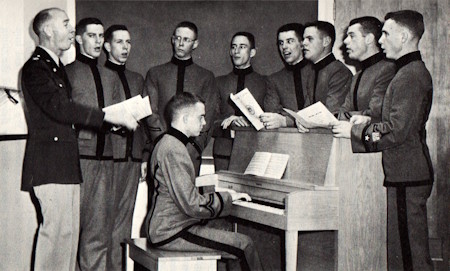
The VMI Glee Club originated in the 1930’s from a group of cadets who gathered to sing on the stoops of VMI’s famed barracks. Among this group was Lt. Colonel Herbert Nash Dillard, the present director, who in 1934, then a first classman organized the group as “The VMI Glee Club.” The Club has been constantly expanded until, at present, it is perhaps the largest of its kind in the South. From 1936 to 1940, it was enlarged and greatly improved under the direction of Mrs. Medford G. Ramey. During the war the Club was not organized officially, but practices were begun again in 1946.
This album is the result of many requests and much interest from the alumni of VMI and friends of the Glee Club. Its range is wide enough both to include old favorites like “The Spirit” and “Stouthearted Men” and to show the variety of the club in its techniques and musical selections. It is intended as a permanent record of some of the songs for which the VMI Glee Club has become known and loved on the concert stage. [Text copied from the original album].
The VMI Miserere
Allegri composed the “Miserere” some time between 1630 and 1638 for exclusive use in the Papal Chapel in Rome where he was a member of the choir. It was sung each year during Holy Week as part of the “Tenebrae” service during which candles were gradually extinguished whilst psalms, antiphons and readings reflected on the mystery of Christ’s death. As the last candle was removed and the Sistine Chapel fell into darkness, the “Miserere” would be sung whilst the Pope prayed in silence.
Allegri’s “Miserere” became legendary because the singers embellished the otherwise simple music giving it an almost mystical quality. The music was also kept secret, and the Pope would not permit any copies to be made on pain of excommunication. Legend has it that in 1770, at the age of 14, Mozart heard the “Miserere” performed in the Sistine Chapel, and wrote it down from memory.
The “Miserere” was first published by Charles Burney in 1771, without the embellishments that made it famous. Mendelssohn transcribed the piece in 1831, although his version was later misinterpreted by W. S. Rockstro, whose musicological error led to the version of the “Miserere” with the famous high C that we hear performed today. How did this sacred music − so long the secret of the Sistine Chapel − form part of the VMI Glee Club repertoire? One can hardly imagine two worlds further apart!
Part of the answer comes from Harvard, where in 1912 members of the Harvard Glee Club were keen to sing a wider repertoire, and particularly to include sacred music. To that end, they asked Archibald T. Davison, Musicologist and Harvard Choirmaster, to coach the Club. Davison expanded the Club’s horizons considerably, introducing them to new musical genres and improving their technique. He also arranged collaborations with the ladies of the Radcliffe Choral Society to perform large scale choral works together with the Boston Symphony Orchestra. The Club appreciated Davison’s efforts on their behalf and in 1919 asked him to direct the group. He accepted, provided that he would be able to choose their repertoire.
In 1922, Schirmer published the “Harvard University Glee Club Collection of Part Songs for Men’s Voices” in six volumes, compiled and arranged by Davison. This made a significant library of music available to other Glee Clubs, and included Davison’s arrangement of Allegri’s original “Miserere” which features in the VMI Glee Club album. Davison’s passion for quality repertoire knew no bounds, and has had wide-ranging impact. In 1925, he even pulled the Harvard Club from a competition, after objecting to some of the required songs on the programme as “silly” and “sentimental mush.” The ensuing controversy was significant enough to be reported in the New York Times.
Unlike Harvard, VMI had no music in the curriculum. So despite Davison’s obvious influence on Glee Club singing in general, what else was needed for the “Miserere” to be part of the VMI Glee Club repertoire? And why should we prevent these recordings from becoming extinct? Both answers involve a unique individual, born in 1913 in Rocky Mount, Virginia, and whose career at VMI was clearly outstanding in many different respects until his death in 1976 − founding member and director of the VMI Glee Club, Lt. Colonel Herbert Nash “Dodo” Dillard.
Herbert Nash Dillard

My interest in the 1949 VMI Glee Club album was initially limited to the inclusion of Gregorio Allegri’s “Miserere”, as my research project concerns early recordings of that work. However I was soon drawn into the wider story behind the album, and clearly that story would not exist but for one man.
“A professor of English and former department head, Colonel Dillard was a distinguished graduate of VMI in the class of 1934 who later earned his M.A. and Ph.D. degrees from Harvard University. Returning to his alma mater, he taught English courses continually at VMI except for leaves of absence for post-doctoral studies and military service. Colonel Dillard was particularly noted for the time he devoted to counseling new cadets, his excellence as a teacher of Shakespeare and English romantic literature courses, and his love of the English language. ”
From an obituary in “VMI Cadet”, June 2, 1976
A detailed biographical record is beyond the scope of these notes. Much can be gleaned from the “VMI Cadet”, “Going Hither, Coming Hence” by his niece, Betsy Dillard, and a special edition of “The Institute Report” which reported his death and described his many qualities. During his post-graduate studies, Dillard was a member of the Harvard Glee Club, as mentioned in “The Harvard Crimson”, May 21, 1936. At that time the Harvard Club was directed by G. Wallace Woodworth, who took over from Davison in 1933. There is no doubt that Dillard’s experiences singing at Harvard will have had an influence on his approach as director of the VMI Club, and I am convinced that his desire for quality and excellence in all things musical would have been as fervent as that of Archibald Davison.
After Harvard, Dillard saw active service with the Navy from 1942. On his return in 1946, he took up the position of Glee Club Director and served in that capacity for 20 years.
“Col. Dillard welded the cadet organization into an accomplished concert group during his twenty years as Director. Singing became so popular under his leadership that auditions first became necessary to limit the size and maintain the quality of the club which became one of the outstanding choral groups in the college field. Under Col. Dillard’s direction the VMI Glee Club appeared in concert with the National Symphony Orchestra, was heard nationally over NBC and Mutual Radio Networks and beamed abroad in ‘Voice of America’ broadcasts, and twice sang for then President Dwight D. Eisenhower.”
“The Institute Report”, February 6, 1976
I was lucky to have tutors who inspired me in the fields of literature and music, and was involved in singing groups similar in spirit to the VMI Glee Club. As I read more about the VMI recording, I recognised a strong parallel with my own experiences − the love of music, the satisfaction of a great performance, the excitement to be had from learning, new places, friendship and camaraderie, and sometimes that same “over-hang” from the night before!
Choral singing was the making of me, and has remained a life-long passion as it may also have remained for the cadets who sang under Col. Dillard’s direction. It has been fascinating to explore the music included in this album and the history associated with it, and I am pleased to make it available again in this edition which may in some small way help to keep the memory of “Dodo” from extinction.
“For Lt. Col. Herbert N. Dillard, not in the least disrespectfully called ‘Dodo,’ who admonishes his English students that outstanding is a word to be used not more than several times a decade, there is but one fitting adjective − outstanding. Col. Dillard is the guiding light and impetus giver to the Glee Club. He has done an outstanding job in directing from the podium, but it is also the additional touch of his friendly, vivacious, personality that has won for Col. Dillard a secure place in the heart of anyone who has ever had the fortune to come into his orbit.”
R. C. Yore, “VMI Cadet”, June 13, 1950
The cadet president of the Glee Club in 1949 was John Taylor. At 92 he still remembers taking part in the recording. His strongest memory is as follows:
“My girlfriend at the time lived in Schenectady. We had been told to be at the RCA Studio in NYC by 10:00 on the designated day. I boarded the train to the city very early, but arrived at the studio an hour late. The rest of the group was formed and already had run through several pieces, which had not gone well. When I came in Col. Dillard sarcastically stated, ‘Well! Now that Mr. Taylor is here maybe we can do something!’ I knew I was in for it. I took my position and we ran ‘Miserere’ and that is the one which was used for the recording. At the end, Col. Dillard broke out in laughter and delight. My tardiness was never brought up again. Music soothes the savage beast!”
John Taylor, VMI 1950, interviewed by Col. K. Gibson
Historical Context
Gershwin’s “Porgy and Bess” attracted controversy due to its depiction of African Americans. The Gershwin family was determined to prevent performances of “Porgy and
Bess” in black-face to avoid association with minstrelsy, and required that only Black singers perform the work.
“It Ain’t Necessarily So” required the VMI Glee Club to sing in “the Negro idiom” as indicated in the album notes. This edition uses the text “the African American idiom”.
“Carry Me Back to Old Virginny” was written in 1878 by James Bland, a popular African American musician, songwriter and minstrel performer. It was the State Song of Virginia from 1940 to 1997 when it was retired because the lyrics, written from the perspective of a freedperson, express positive sentiment towards slavery. The album notes mention “the Negro, James Bland” but this edition uses “the African American songwriter James Bland”.
In 1949 the VMI Glee Club contributed to a Minstrel show, as reported in the “VMI Cadet”. Minstrel shows that included performances in black-face were an annual event at VMI and other colleges across America. To put this in context, in the UK “The Black and White Minstrel Show”, a BBC TV programme, was still broadcast until 1978. VMI Cadets fought in the Civil War under Confederate General “Stonewall” Jackson, who taught at the Institute, and owned six slaves. Slavery was abolished in 1865, but racial segregation was only completely outlawed in 1968. Segregation in public schools ended in 1954, but VMI only accepted its first Black cadets fourteen years later, also in 1968. Cadets were required to salute a Jackson statue in the parade ground until the practice was ended in 2015.
In May 2020, early in the COVID pandemic at a time of heightened global anxiety, African American George Floyd was killed by a white police officer whilst being arrested in Minneapolis. His death triggered worldwide protests in support of the Black Lives Matter movement. In October 2020, the Washington Post claimed that “Black cadets still endure endless racism” at VMI. The VMI Superintendent resigned, the Jackson statue was removed, and an independent investigation into racism at VMI, called for by the state governor, started in December 2020. In June 2021 the final report of that investigation claimed that “institutional racism and sexism are present, tolerated, and left unaddressed at VMI”. Superintendent Maj. Gen. Cedric T. Wins responded that “the facts simply do not support that position” but acknowledged the need to take action. Appointed in April 2021, he is the first Black man to hold the post of Superintendent at VMI.
Over 70 years have passed since the VMI Glee Club travelled to make their recording at the RCA Victor studios in New York. Despite that, recent events at VMI and the nature of some of the material made me question whether to re-issue all the songs or just the “Miserere” that had been my first interest. After much reflection, I stand by my intent to highlight the complete musical endeavour of those involved in the contemporary recording. I hope that others will, as I have done, use this as a catalyst to learn about the historical context of the period and the musicological background to the works recorded by the VMI Glee Club.
About the Audio Restoration
After cleaning, each disc was played on an Audio-Technica AT-LP5X direct drive turntable fitted with a VM95 series 78rpm SP cartridge on an AT-HS6 headshell. This simple
setup allows audio to be captured via USB output from the turntable, although an additional, higher quality phono stage that also provides a USB output has since been used to offer a greater degree of control over the process. Recordings were made using Audacity before being transferred to Adobe Audition for restoration. Whilst more advanced equipment and techniques could be used to create archival quality recordings, the additional expense and complexity would be unlikely to increase the quality of the output relative to the quality of the source material – and more time spent exploring Audition’s powerful feature set would likely be much more beneficial.
The original copy of the album obtained via eBay was in rather poor shape, and gave no clues about the original owner. Each of the paper sleeves containing the four 78 rpm red vinyl discs was home to a few seeds, dried plant matter and mouse droppings, suggesting the copy had been stored in a shed or garage at some time. The discs themselves were in fair condition; some were more stained, scratched and worn than others. They were lightly cleaned before recording them for the first time, in case more extensive cleaning caused damage. Each disc was then cleaned more thoroughly before making a final transcription to use for digital restoration.
Each mono track was restored using a combination of techniques to remove “pops” and “crackles” and to reduce the level of background noise. Most remaining blemishes were then removed one by one using the various repair tools available. In some cases, a blemish was left intact if a repair was impossible without causing a more frustrating reduction in clarity. Each restored track is available in two-channel mono and in original WAV, FLAC (Lossless), and MP3 (320k CBR). Some of the tracks fair better in the restoration process, and it appears that the degree of wear across the eight sides of the records is rather variable. We have no idea how many times they have each been played over the years, but it is clear that they have been enjoyed, and can now be enjoyed once again.